
I was sitting with my husband Liam one evening. You know, a nice quiet, relaxed and calm evening watching Homeland, Season 6.
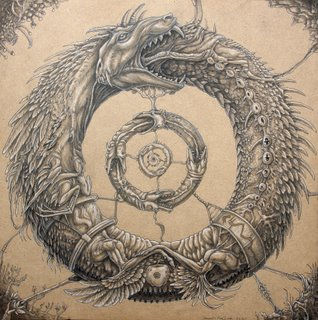
Let me clarify because calling any episode of Homeland “relaxing” or “calm” is like calling a root canal “refreshing” or a car crash “meditative.” Season 6 continues the joyride of what seasons 1 through 5 have provided: more of Carrie’s never-ending morally impossible choices, her being labeled as unstable by those she was nothing but loyal to, the continued unfolding of Central Intelligence’s foundational rot, the ouroboros of empire eating itself.
Good times.
So yeah, you find yourself sitting on a nice, comfy sofa (calm) with your beloved, maybe with a glass of your favorite beverage in hand (relaxing). Meanwhile playing out on the giant black mirror in front of you – ours happens to be 65 inches – you bear witness to your favorite characters dying, becoming near-lobotomized, or, the most relaxing of all, tortured to within an inch of death. Then you get the opportunity to watch their entire identity shattered and reassembled, with some of the most vital parts missing. Heart-breaking turn of events followed by another heart-breaking turn of events, resulting in some masochistic heart-punching feeling that you, the viewer of this torturefest, package up and accept as “the plotline.”
It’s a car wreck you can’t take your eyes off. Eventually you’re a bystander, having escaped the vehicle sometime before, standing there as observer, unable to peel your eyes away as you witness the chaos unfold, counting your lucky stars it’s not you being subjected to impact. The Germans have a word for that feeling of not being able to look away: schadenfreude – essentially: the deriving of enjoyment or entertainment value from the pain and agony of others. You and your beloved engage in the schadenfreudian unraveling of truth-tellers, protectors, and loyalists. You passively view this plot line unfolding while your poor nervous system screams “UNCLE! U-N-C-L-E!” but you can’t take your eyes from the crushing metal of it all.
It’s like eating potato chips – you can’t, and you don’t, consume just one. You must stick around to see how the plot unfolds, how this story culminates in its same old punchline: power corrupts, there are no happy endings. The weak and kind-hearted and empathetic are mercilessly destroyed, but you first get a healthy helping of their pain and suffering. For dessert? More megalomania disguised as intelligence gathering. Would you like a cup of espresso to follow?
That’s what good television does. It makes you feel like YOU need therapy while watching people who definitely need therapy try to clean up messes made by powerful megalomaniacs who are the cause of a lot of the world’s therapy needs in the first place. Good people pay for the bad deeds done unto them and the doers of those deeds rarely seem to pay a price.
The whole show is a variation of Robert Greene’s genius (and distrubing) work: “The 48 Laws of Power”. except instead of reading about manipulation tactics, you watch Carrie live through them while Saul wields them. It’s a masterclass in how power operates: ruthlessly, invisibly, at this woman’s expense.
Anyway – season 6.
Liam and I are in the midst of watching a scene unfold where Carrie – who is inevitably trying to do the morally correct thing, trying to get a kid out of trouble that she truly believes is innocent, freed from the FBI’s clutches – makes a decision. Never mind that there’s no place for moral correctness in the plot of Homeland. Never mind that in this particular scene the kid was set up by an FBI informant, with more corruption unfolding in the scenes to follow.
Liam says, in absolute seriousness: “Man, she’s always fucking shit up.”
Wait. What?
I took a good look at him, recalling the other times he’s said similar things about Carrie’s character as well as some of the other female-centric narratives in the show. I just stared at him and said: “Wow Liam, that was incredibly misogynistic.”
This phrase coming a man who grew up in an all-female household.
Who has sisters.
Who works full-time in a female-dominated profession – he’s a nurse.
Who has a daughter.
Who’s been married for nearly two decades to a strong, somewhat stubborn woman with strong female lineage. Us Slavic women are no slouches.
He just stared ahead, I know he heard me as I can tell he momentarily contemplated a reply. Instead: silence. Pretended to ignore me. Continued watching the next scene unfold. Which was nearly hilarious in its positioning next to what we are to believe is Carrie’s screw up.
In that scene that immediately follows, one of the male main characters (Saul) uses a honeypot[1] to entrap an Iranian banker. This was not only questionably legal (never mind ethical), it also exposed Saul’s safety and well-being – as well as the entire ecosystem that supports his work as an intelligence officer – to serious risk.
Upon reflection as I type this blog post, it occurs to me that Liam’s silence spoke volumes. Not because Liam is overtly misogynistic – he’s far from being womankind’s enemy – in many cases I would say he is actively pro-woman. But because his reaction was reflective of the STRUCTURE behind misogyny.
Because this is how misogyny works. Not through conscious hatred but through the invisible patterns of WHO we notice, WHAT we remember, WHOSE mistakes matter. It’s insidious, weaving itself around narrative and integrating itself into thought patterns.
It maintains power via structures that are all but invisible to the naked eye.
In his statement about Carrie always messing up situations, I didn’t hear him call out the need for accountability of those men who were creating massive errors with resultant devastation and destruction. Once in a while Saul gets caught in crossfire – sure -but Saul’s wife? She never received any grace. She was having an affair when none of her needs were being met, and Liam blamed HER. It was my coming to her defense, who finally said: ‘Saul promises one thing and does another. This is very indicative of what we should expect from him!’ That’s when Liam finally noticed Saul’s pattern – his obvious disregard for the women in his life (his wife, his sister, his ex-fiancée, CARRIE). But in the context of the show, Saul’s failures just get chalked up to ‘this is how the world works’ without anyone questioning: why does the world work this way?
This pattern isn’t new. It’s not unique to Homeland or prestige television or 21st-century intelligence agencies. It’s ancient. Structural. Inherited.
The Nobel Prize-winning Polish poet Wisława Szymborska knew it. Wrote about it. Lived through it.
Her story is one of fire, persistence, and poetry.
ON BROOMS, REMEMBERING, AND POETRY THAT REFUSES TO LOOK AWAY
In 2012, when Szymborska passed away at age 88, The Nation had a beautiful write up about her life’s work: “The New York Review of Books’ Charles Simic called her poems “poetry’s equivalent of expository writing,” which captures their accessibility, their logical clarity and their interest in facts (especially odd ones), stories, things and people, but doesn’t convey their charm or vitality. Expository writing is, after all, a required class for college freshmen—the opposite of fun, dazzle, originality, pathos.“
For me, Szymborska’s signature quality is the way she puts tragedy and comedy, the unique and the banal, the big and the little, the remembering and the forgetting, right next to each other and shows us that this is what life is.
Her poem “The End and the Beginning” does exactly this. It names what Homeland often shows, what everyone who survives sees and experiences but rarely says: after every war, someone has to clean up. That someone tend to always be women.
Szymborska knew this because she lived it. Her work didn’t start in classrooms or cafés—it started in the rubble of WWII Poland. She had survived Nazi occupation
Szyborska’s work started during WWII Poland. Szymborska had survived Nazi occupation, continuing secret studies, when education of Poles was outlawed, graduating in 1941. She then later studied Polish language, literature and Sociology at Krakow’s Jagiellonian University until war conditions forced her to stop in 1948.
She witnessed unspeakable horrors – waged not just against Polish people, but against all who lived in Poland during those years. Her beloved Polska[2] filled with wreckage, the aftermath of violence: the kind only human hatred (or more accurately lust for power and possession) can create.
She watched men start their wars. Conduct them. Then leave.
She watched women – survivors, like her – clean up after. Without pomp or press or even a dj or a band. Clean up took place, one sweep of the broom at a time.
After every war, someone has to clean up. Someone, broom in hand. Someone whose sleeves are ragged.
When I was a little girl my mamusia [3] would sometimes read to me from her favorite Polish authors. These were the kind of works that had built in life lessons so as not to be obvious about the parental lessons she wanted to impart upon my psyche. Szymborska’s poetry was part of the fabric that was woven throughout my childhood. I remember mamusia talking to after reading the poem – she would sometimes say: “Grażyna, that someone she writes about, who is left behind, holding the broom with ragged sleeves? That tends to be women’s work, the unseen, silent hand cleaning up messes that men made!”
The persistence of clean up.
Even Polska’s national anthem isn’t about victory or glory. It’s about persistence, endurance, SURVIVAL. “Jeszcze Polska nie zginęła” – “Poland has not yet perished.”[4] Written in 1797 in Italy during the partitions when Poland was already erased from maps. The bar wasn’t “Poland is great.” The bar was “Poland is not dead YET because we (Poles) still live.”
That’s the inheritance. That’s what Szymborska knew. That’s what mamusia taught me. Survival isn’t glamorous. Persistence isn’t photogenic. It’s simply: we’re still here. We’re still cleaning up. Don’t write us off, yet, we aren’t dead yet[5].
Szymborska wrote the poetry that could narrate the art of cleaning up. The beneficiaries of post conflict PTSD. Those who are left after the news media leaves, after the cameras are shut down, after the “glory” of bloodshed.
This is how I interpret Szymborska’s “The End and the Beginning” as it relates to my world and those in it (fictional and not-so-fictional characters included):
“After every war
someone has to clean up.
Things won’t
straighten themselves up, after all.”
My Babcia cleaned up after WWII. Literal rubble in her small village. Literal corpses to pull to the side of the road. She was eleven her dad was hung in a neighboring village by occupiers. Someone in her village had to push bricks aside so wagons could pass. Guess who? I assure you it wasn’t the Nazis who destroyed her village. Certainly it wasn’t the Soviets who “liberated” it. And we already know it wasn’t the politicians redrawing Poland’s borders in distant conference rooms.
Some girl with a broom, hair pulled back with a babushka, worn down dusty shoes, clothes so worn they’re tattered with ragged sleeves. Invisible hands.
I cleaned up after my near-death in 2013. Not literal rubble – medical records. Over three hundred pages of documentation: bureaucratic failure after failure outlining how I bled out translucent, not once but twice. Once on an OR table during one of the alleged most happiest times of my life – my daughter’s birth. The second overnight while nurses all but ignored my pleas when I cried repeatedly that something was wrong. I nearly died TWICE because some man lacerated my uterine artery and (pretended) thought they’d fixed it.
Someone had to read that chart, make sense of the catastrophe, try to find accountability in pages designed to obscure it. Guess who? Not Dr. OB. Not the hospital administration. Not the legal system (no case – I was told I survived, so apparently no damages, also “she’s a nurse she knew her risks going into the c-section”). Me. I cleaned up. I pulled every page, read every failure, pushed my trauma-rubble aside so I could mother and wife and photograph and perform “fine” for everyone who needed me functional. Photography being my only escape, the new baby I could nurture as my two children grew to not need me as much. That which saved my sanity also sustained me in other ways.
Homeland: Carrie Mathison cleaned up after Saul Berenson for six seasons. Pushed aside his compromised operations, his moral failures, his inability to protect the people he claimed to love. She cleaned up after Quinn died, after Brody was executed, after Dar Adal manipulated everyone. Someone had to make intelligence work function despite the corruption. Someone had to push the CIA’s corpses aside so the wagon could keep rolling. Carrie. With ragged sleeves and no credit and a whole lot of shade.
Things don’t straighten themselves up! Someone, some invisible woman,has to do it.
“Someone has to push the rubble
to the side of the road,
so the corpse-filled wagons
can pass.”
Babcia: literal rubble. Literal corpses. Post-war Poland, 1945. Need I say more?
Me: massive medical failure (300+ pages), the trauma memories (feelings of imminent doom pre surgery, “oh shit!” lacerated uterine artery, bleed internally until translucent, ignored, almost dead), the emotional wreckage (PTSD label, marriage strain, guilt over not being able to breast feed due to massive blood loss, then eventually hypothyroidism via Hashimoto’s Thyroiditis: an internal attack on my thyroid because my body can’t forget what my mind tries to). I push it aside daily. Pack lunches. I smiled for patients and their families. Later I smile for photo clients. When someone asks “HOW are you?” I answer a simple “I’m fine”. No one wants to hear about the emotional clean up that’s been taking up my headspaces for 12 years! The corpse-wagon of my almost-death keeps passing through my life, and I keep clearing the path so it can. After all: I’m not dead yet.
Carrie: Quinn’s body. Brody’s execution. Saul’s failures. Every blown operation, every compromised asset, every moral catastrophe the CIA creates then abandons. She pushes it aside. Keeps working. Keeps cleaning. The agency’s corpse-wagon rolls on. Someone has to clear the road.
So often women. Nearly always invisible. Always still holding the broom when the cameras leave. No pomp, no circumstance, no grand parade. Just more sweeping and moving bodies aside for the next era of destruction.
“Photogenic it’s not,
and takes years.”
There’s no honeypots assigned to broom work. No sexy operative flipping her hair and seducing her way through rubble. There is no slo-mo movie montage of women cleaning up after war with their hair being blown back by a gentle breeze. Just ragged sleeves, invisible hands and years of pushing corpses aside so life can continue.
Babcia spent decades rebuilding what men destroyed in months. Her efforts weren’t celebrated nor photographed and not memorialized by anyone but her own daughter that taught it to me. Patrz, pamiętaj. Look, remember.
It’s taken me 12 years to re-build the framework of something that the hospital dismantled in less than 24 hours. Journaling. Counseling. Labwork. Housework. Caretaking of others. Medications and vitamins for newly diagnosed medical conditions. Push back the grief often enough that it can stand on its own, awaiting its next turn up in my brain.
Learning to trust my body again – after my instincts were minimized by a system that nearly killed me and tried to lay blame on me for their errors. No one would choose to photograph this. Nobody celebrates the anniversary of “she didn’t die.” It’s just me, myself and I: remembering, marking the passage of time until it feels less palpable. Still pushing aside the rubble of that less than 24 hour period. Trying to live through this. Pushing the tears aside.
Carrie spends entire seasons cleaning up CIA disasters. Not photogenic. Not honored. Certainly not promoted. Just: do it again. Fix it again. Clean up again. Rinse. Repeat. It takes years. It costs everything.
The cameras have already departed for the next thing…
“All the cameras have left
for another war.”
Men move on. Women stay to pick up the pieces. Men create the mess, declare it handled, move to the next conflict. Women stay behind with brooms, cleaning what men called finished, handle what needs to be handled.
The hospital, my beloved Dr. OB? Each moved on from my near-death the moment I didn’t die. Case closed. Patient survived. “Be grateful.”, “You could be dead.”, “You are so blessed.”
NEXT!
The cameras left. I’m still here, cleaning up the aftermath twelve years later, wondering if I’ll ever stop bleeding emotionally even though the physical blood stopped in 2013.
Babcia watched the world move on from WWII. Declaring it over. Victors write the history[6]. They build memorials for soldiers, conferences for politicians. The cameras left Poland. Women with brooms stayed, rebuilding in silence. Rebuilt under oppression.
Carrie watches the CIA move on from every blown operation. Declare it handled. Promote the men who caused it. Send her back into the field for the next disaster. The cameras follow wars, not cleanup. Follow explosions, not the women sweeping up shrapnel after.
We’re still here. Brooms in hand. The cameras are gone. The wars continue. We keep sweeping, we keep cleaning rubble from the road. No pictures, please. Oh! You didn’t bring a camera. Oh. Ok. We shouldn’t be remembered like this anyway, we are so unimportant as the in-betweens, those that clean up after the important men that start wars – they get the statues!
“Someone, broom in hand,
still recalls the causes.”
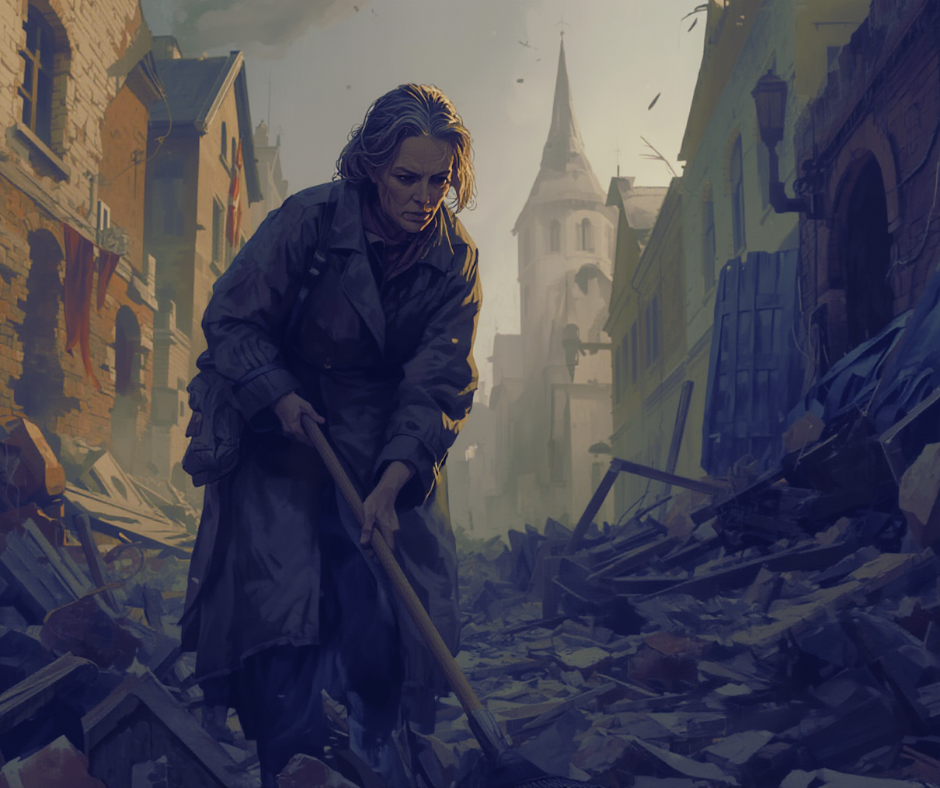
Yes we do, we remember lest those that come after us forget – and eventually they will. Babcia never forgot why her village was in ruins. She remembered the spoken history that only survivors can give. She remembered who gave the orders, which men followed the orders amongst those she knew. She remembered the signed treaties that all-but-erased Poland from the map for the fourth time in 300 years.
You think I forgot the tone in Dr. OB’s voice when he said “oh shit” on the other side of the surgical drape? When my right went straight as a pin of its’ own accord when I was already numbed with an epidural anesthestic. Do you think I forget the shadowy nurses working night shift who gave me Vistaril to shut me up when I said I was in pain rather than placing 2+2 together? That I was there after many hours of blood loss post c-section? Did I forget when I went through depressive episode after depressive episode – likely from the trauma and the PTSD of it all but also the thyroid that cried and waved the white flag while my doctors told me repeatedly: “You’re fine, you’ll be fine.” Or the attorney who said “if she’d died, the family could sue, but she survived, so you have no case”? The legal system that protects doctors because in my state where rules exist that require an MD to certify you have a case no MD in the brotherhood would testify against Dr. OB? Did I forget the words uttered by our legal nurse consultant, who was so shaken up because she knew we had a case and she had to tell us that the consulting MD said to her: “Well she’s an RN, she knew the risks of going into a c-section surgery.” I’ll never forget her voice quivering on the other side of the phone because she knew it could be any one of us that this happened to. Maybe she was also counting her lucky stars.
You think Carrie forgot Saul using her, Quinn dying because of CIA failures, Brody executed after she promised him safety? Do you think she forgets Brody’s face at the end or every time she looks at her daughter?
Someone with broom in hand still recalls. That’s the job. Clean up the mess AND remember who made it but you’ll never get to call her HERstory. No, they made sure to mark that as well.
Women don’t get the luxury of forgetting. We’re the ones left holding the broom when everyone else has moved on.
“Someone else listens
and nods with unsevered head.”
Rarely. So rarely someone will be willing to dig through the mess to finally hear the voices amongst the rubble.
Most people aren’t willing to make space to hear it. Comfortably numb. They don’t want to know about the inconvenient parts of war: the wreckage, the broken bricks, the twisted steel, the remains of those who fought and worse: those of the innocent. The years of laboring to tidy up the spaces, the causes we still recall. They want us to be done with it, already. Healed with at least a scar but that might be ugly, so cover it it. Get over it. Be quiet. “You are so blessed to have survived!”
Dr. K listens. Mostly. When I’m not spending twenty minutes ranting about private equity destroying Red Lobster instead of discussing my marriage and my believing that the rant is about mourning cheddar biscuits instead of the slow bleed of a blessed union.
Babcia worked along other survivors. Her friends and neighbors. Women who cleaned and bonded alongside her. They mourned the loss of what once was with each other. Recalled together. That’s why my mamusia taught me Szymborska. Someone has to listen. Someone has to witness the witness, my babcia is no longer here but her memories of what was and what went down live on in Szymborska’s poetry.
But most people? Most people have already moved on to the next war along with the news media who lives to perpetuate the feelings of schadenfreude. The next crisis for your attention, your eyeballs.
The next photogenic disaster to capture your heart, mind and instill a sense of fear of everyone and everything around you. Because without the schadenfreude you wouldn’t have the possibility of instilling fear, anxiety and eventually creating the complacency so needed for business as usual.
The people don’t want to hear about brooms and plus the honeypots won’t participate in the clean up to make it sexy. Ragged sleeves, women recalling what went down? That is for intellectuals, thinkers, philosophers and revolutionaries. So we regular people? We write it down instead. Revenge of a mortal pen!
“In the grass that has overgrown
causes and effects,
someone must be stretched out
blade of grass in his mouth
gazing at the clouds.”
HIS mouth. The one described as resting is a him. The masculine.
Finally…FINALLY Szymborska genders it. After eighteen lines of “someone” doing the cleaning, the recalling, the pushing of rubble – we finally get to describing HIM.
The man stretched out, nice & comfy with a blade of grass in HIS mouth. Staring at the floating clouds above. He is unbothered, unencumbered, completely free from the causes and effects that women with brooms still recall.
Last I checked my Dr. OB still practices medicine. The hospital where I nearly died still operates, they even expanded and upgraded their dominion – new glass and steel high into the sky. Those administrators who ignored my case still administrate. The legal system that dismissed me continues to dismiss women who survive instead of dying – conveniently enough to sue.
They’re all stretched out. Blade of grass in mouths. Lazily gazing at the clouds. Causes and effects overgrown. Forgotten. Someone else’s problem. Some woman with a broom will handle it.
Babcia watched on as many of the men who started the war – the ones who survived – retired to comfortable lives. They wrote memoirs. Were interviewed about their strategic decisions, they received accolades and pats on the back for killing, maiming, destroying. They used double speak and pronounced peace all the while with their blades of grass in their mouths and the billowy white clouds above.
The rubble that remains? Someone else’s concern. Maybe some Polish girl, who was denied an education, with a broom.
Carrie watches Saul get promoted. She watches the CIA move on. Watches her paternal Saul get honeypotted himself! She watches politicians who created disasters retire to the revolving doors of modern empire: consulting firms and book deals and much more legacy-building. Stretched out. Comfortable. Someone else cleaning up their messes. Some woman with ragged sleeves they’ve already forgotten, no for Carrie it would have been far better for her to have been forgotten. Instead she was gaslit, manipulated further, her life messed with by the very force that she fought so hard for. Carrie doesn’t get a blade of glass (at least not during season 6 where we currently live with her on our comfy sofa with drink in hand).
That’s the pattern. Women provide the manpower, do the labor, clean their messes, recall the causes of what went down. Men receive the credit, move on to new wars, gaze at clouds, forget everything except their own comfort. The revolving door of empire in another form.
But always there is someone left holding the broom, remembering.
Patrz, pamiętaj – my mamusia used to tell me as she gave me advice about men making messes.
Look. Remember.
That’s woman’s inheritance.
That’s the work.
[1]Honeypots exist because men are easy targets. Their sexual vulnerability is so reliable that intelligence agencies weaponize it routinely and it plays out as pretty sterotypical on subscription tv. The fact that the Iranian banker isn’t an exception – he’s the RULE – gets totally glossed over. Men get compromised this way constantly. But we don’t call it “male weakness.” We call it “intelligence operations.” And when things go south we often blame the women involved, like the operative following orders or Carrie cleaning up the messes three episodes later. Men’s exploitability = invisible. Women’s actions = problem. Always. We won’t even dive into the mess that Saul creates for himself this season. Left Carrie out in the cold a season or two ago only to be backstabbed by the same dude. Saul. Saul. Saul. Why does anyone trust the dude?!
[2] Polska, what we Polish call the “fatherland” – Poland. What Poland is and a brief history of the past 300 years: You have a gorgeous country. Fertile land. A strategic location. A population with rich culture grounded in Slavic Pagan spirituality and Christianity. So naturally – everyone wants a piece. Russia, Prussia, Austria carved it up three times (1772-1795), erased it from maps for 123 years. Poland went POOF! Totally disappeared. I’m not talking in metaphors – Poland was literally erased from European maps for 123 years. Then WWI briefly “restored” it, just in time for WWII when Nazi Germany and Soviet Union decided to invade and split it again (Molotov-Ribbentrop Pact, 1939). You’d think being invaded, occupied, and partitioned repeatedly might earn Poland and its’ people some sympathy. Instead it earned more invasions. Poland’s only crime? Existing in a location powerful neighbors wanted. The lesson? When empires can’t play nice, they just divide what they want and call it “geopolitics.” Poland calls it “our entire history.” Szymborska knew: beautiful things get destroyed by powerful men who want to possess them.
[3] Mamusia – pronounced: mah-MOO-shah: Polish for “mommy.” Mispronounce it at your peril and good luck to you! Polish mothers can communicate disappointment through silence, deep sighs and a strategic single eyebrow raising. My mamusia used to read me Szymborska’s poetry between sips of warm tea sweetened with honey (from the real honey pot, not the “intelligence” variation) as I leaned on her on our roomy living room sofa when I was a child. Talk about real calm! Mamusia taught me early: men make messes, women clean them up. That’s the inheritance. Maybe it’s even the real mortal sin waged upon mankind since the days of Adam and Eve.
[4] Mazurek Dąbrowskiego” (Dąbrowski’s Mazurka) – First lines, in Polish: Jeszcze Polska nie zginęła, Kiedy my żyjemy. Co nam obca przemoc wzięła, Szablą odbierzemy. – English translation: Poland has not yet perished, so long as we still live. What the foreign force has taken from us, We shall retrieve with a saber. Written in 1797, in Italy, during partition (Poland erased from the map) and adopted by the post WWI Polish Nation when Poland was briefly “restored” after 123 years. The bar wasn’t “Poland is great.” The bar is “Poland is not dead YET.” That’s the inheritance. That’s what Szymborska knew. That’s what mamusia taught me. Survival isn’t glamorous. Persistence isn’t photogenic. It’s just: we’re still here. We’re still cleaning up. We haven’t perished yet.
[5] Monty Python’s Holy Grail got it right. “Bring out your dead!” – “I’m not dead!” – “Yes you are, shut up!” May as well serve as the unofficial transcript of Pole’s conversations to European empires for that 123 year period from 1795 to 1918 and a good part of the 20th century. This also serves as a commentary from women to every system that tries to erase them. The plague cart keeps coming. “Bring out your dead!” Yet we keep refusing to get in. Very inconvenient. Still not dead. Still here. Still annoying people by surviving.
[*} Briefly, simply to touchstone a point that fits in comfy here in the footnotes because we’re already on the topic of Monty Python’s Holy Grail anyway. From the film: “Strange women lyin’ in ponds distributin’ swords is no basis for a system of government.” Dennis was right, Arthur’s entire legitimacy as KING rested on the Lady of the Lake giving him Excalibur. Suddenly that “farcical aquatic ceremony” became divine providence. Normally men are found dismissing women’s power as illegitimate UNLESS it’s currently useful for a narrative. Then it becomes sacred, essential, the foundation of their authority. Think about all the oracles that had been dismissed and ostracized as witches until some king needed a prophecy. Very convenient. “We have an oracle here at the edge of the woods banished from the town – go fetch her so she can be of use for this prophecy we need.” Women’s healing and restorative powers dismissed as superstition until men need care. Honeypots dismissed as “just sex” until CIA needs intelligence. Women’s threshold work dismissed as “hysteria” until systems need us to clean up messes. Arthur got his magical sword from a woman. Bet she didn’t get credit for his victories! But when things went sideways, I’ll wager someone blamed her anyway, Dennis certainly blamed that “watery tart“. Blame waged against women’s moves happen often enough to call it a pattern. Women provide their innate power and wisdom, some man will claim credit – a group of men mess up, a woman gets blamed with the BONUS! added benefit of being called a slut. Or a watery tart. Or moistened bint. A moist slut, if you’re American.
[6] It’s never HERstory. Always history.