
“Karen” Is A Psyop: How Corporations Weaponized Shame to Create Obedient Consumers
In late December 2025, I endeavored to create this site – maybe as a distraction from writing the book I’m writing about my life, maybe as an add-on. Listen, I have a lot to say, and I figured I should say it somewhere other than in a book because I’ll get off-topic too fast.
So yeah, that was the initial reason for creating the site. But it was an encounter with a tech bro – and my own reaction to 40 minutes of his apathy, gaslighting, and tinkly piano hold music – that had me write THIS post about memetic psyops and silent wars.
Heavy, huh?
That customer service agent deep fried my brain. He (had no way of knowing that he) was gaslighting someone who’d been creating websites since probably before he was born. My aha moment came when I realized: “Hey, this is a footnote worth expanding somewhere.” Boom! 2 hours later,* this first entry on edgealia.com was birthed.
*lies, it was about 36 hours later after a lot of work on the “backend”
In that 36 hour period I purchased domain name via my hosting company and then the SSL for edgealia.com. I was on a roll! (YAWN, listen, bear with me because this boring tech tale has a great payoff, pinky swear!) Obviously I eventually succeeded, because you’re here and you see that stupid padlock in your browser address bar (or maybe it says “secure” – your internet browser is your business). I paid $25 for that privilege. I don’t know what it really does, other than verifies my site as “safe” (from who?) but my other websites are bricked in terms of SEO (search engine optimization) because they don’t have it. As I said, it’s supposedly a security thing, ok then. I’ll tell you: It’s a big ole headache for those of us who’ve been playing on these interwebs forever – us elder Millennials who geeked out in HTML code rather than lurking on MySpace. You know: the freaks, geeks, weirdos, and autistic-adjacent among us. Not sure why I need the “s” in https: but here we are. Needing to pay for things that we didn’t used to have to. Seems like that’s our world these days.
Anyway, the way my server file structure is set up is a major hassle. I get it, I’m partly responsible as is my hosting company (who inserts websites in weird places when I do their “click n build”. Sure it’ll build it but good luck finding it when you need to make adjustments in the file structure of your server).
As you can see: I probably need a massive overhaul of the whole thing. It’s a headache. Admittedly partly due to my lack of executive function skills and partly because I know enough to be dangerous, to screw things up but also not enough to fix them. We should invent a name for that level of (in)competence. Also in the background of {waves hands} all of this, I have Stockholm Syndrome with my hosting company and I just hand them money periodically to fix things that used to be functional but now suck. There’s a lot of those things. I’ll add them to a list somewhere.
I was talking to Claude – my AI genie in a server cloud, you know, because I can no longer navigate the infrastructure of my websites without consulting the smokeless fire genie, ahem, a third party. Rubbing the magic djinn lamp for some assistance and whatnot. The issue I was experiencing? Not even my djinn could help me. Nope. Claude said: “Call [your hosting company]. Good luck. Here’s their phone number.” Then he/she/IT let me loose.
I had to talk to a real person for “customer service”. Yuck.
Normally I don’t mind people-ing, but wannabe-tech-bros sitting somewhere in a far-flung land getting paid hourly and referring to some manual on how to deal with customer complaints is like the last thing on my list of things-I-wanna-do-for-kicks.
The tech bro pal I got hooked up with? His name is (allegedly) Ralph.
Ralph spoke with a vague accent[1] I couldn’t put my finger on, which – whatever. His accent was not my issue at all. I’m very used to accents being a first generation American. It was his tech misogyny, his tech bro-ness that resulted in a profound lack of listening skills while a woman was talking, nevermind the level of her knowledge regarding the topic at hand.
His unwillingness to hear my actual issue, maybe-probably because I am a woman. Also I can more than likely guess it’s also because I interrupted his Sunday work time while he was in the midst of his 3rd watch through of Game of Thrones on the tablet that sits next to his work monitor…or maybe porn, really none of my business. My money is on his at work activity not being sponsored by the C-suite at [your hosting company].
I had this suspicion that if Liam, my husband, was making that call – knowing nothing about servers, just saying: “Hey man, my wife’s website is down, can you help me?” Ralph probably would’ve fixed it in 10 minutes. No mansplaining. But I called with 20 years experience on the “back end” [2] and got 40 minutes of condescension.
Was that because I’m a woman? Maybe. Was it because Ralph’s undertrained by [your hosting company], normally gets through his 8 hour shift by reading from a script, and I (so rudely) interrupted his Sunday Game of Thrones binge? Also maybe. Either way, I questioned myself: “Am I being a Karen?” instead of questioning Ralph’s competence.
That’s what the psyop does. It makes YOU, the customer, the problem, not the system itself.
Me to Ralph, near yelling on phone after telling him this three times already: “Listen, Ralph, [hosting company] broke my website because they tried applying the SSL on my main site and now my BUSINESS WEBSITE is broken, which sits in the ROOT of my back end. And yeah, the SSL isn’t working on edgealia.com either. Check the .htaccess[3] for me will ya? And make the changes back so I can have my site back. Please?”
Ralph “dove into” my web infrastructure and tried mansplaining what he believed the issue to be – not at all referring to the facts I’d mentioned above. Pointing me to directories where websites live but NOT the websites in question.
Nearly 40 minutes later, the situation was finally resolved. But not before I went all “Karen” on him.
How did I feel like I was “Karening”? I had to re-explain the situation in tech bro speak: “You need to fix my .htaccess for my root directory, Ralph. I’ve said it several times.”
“No Ralph, the ROOT directory houses my actual business website, not the million other folders you keep trying to point me at.”
“Ralph, I’ve hosted with your company for nearly 20 years for various websites. I’m about to take my business elsewhere.”
These conversations – the acknowledgment of my personal Stockholm Syndrome State with this hosting co. that extracts money hand over fist like a mob protection racket plus the sunk cost of an aggravating 40 minute phone call of tech-bro speak and being put on hold no less than five times[4] – made me question something as I was near yelling on the phone:
“Am I being a Karen?”
That didn’t sit well with me. I quickly dismissed it and started questioning: “Wait a minute! Why do people mock it when you need to go “all Karen” on customer service agents or other representatives of corporate interests?” then the revelation:
“It all feels a bit…weaponized!”
So I did the deep dive. Turns out, my questioning the “Karen-ing” of it all? Very justified. Let me explain.
Going Full Karen
A few of my favorite people are actually named Karen, funnily enough, so the “Karen-ing” of the customers of America has always kind of sat poorly with me.
Also as of 2020, the name KAREN sat at 637th in popularity for girls. During the 1950s and ’60s – peak Baby Boomer years – “Karen” was consistently in the top 10 for girls’ names throughout those decades. So the name itself probably draws a picture of a complaining Boomer, a sheltered white housewife with “all the time to complain” on her hands.
But then, one of my favorite people? My cousin Karen! She’s definitely not a Boomer, but she is funny, hellaciously smart, and has college degrees in things I can’t even wrap my head around explaining. So when the Karen meme became a thing in 2020, I was…well…a little disgusted on her behalf.
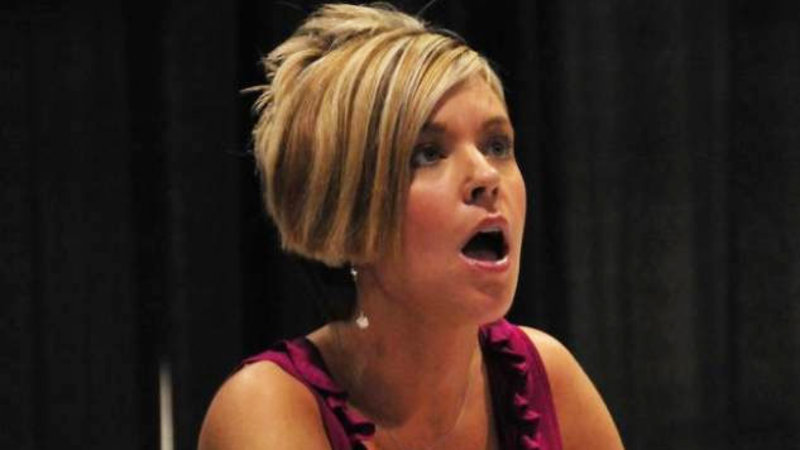
So what is this Karen meme, exactly? It originally referenced a specific type of middle-class white person (skin color) who exhibits behaviors that “stem from privilege” or that act “excessively demanding”. I use that quote because obviously it is so widely used now, “KAREN”, that no one is even referencing class or skin tone at this point. We even refer to some men as Karens.
Karen memes sometimes include portrayals demanding to “speak to your manager” and wearing a particular bob cut hairstyle. The memeification of “Karen” was popularized at the start of COVID lockdowns, in the aftermath of the Central Park birdwatching incident of 2020. You know while we sat as captive audiences in our homes tucked in nice and cozy, far far away from the big bad.
A woman named Amy Cooper called the police on a Black man, Christian Cooper, who was birdwatching in Central Park. Her dog was off-leash and he had asked her to leash her dog per park rules[5]. Her actions were widely criticized, especially since the call to the police was perceived as an attempt to weaponize her race against him. The incident quickly went viral on social media, given that we were all a captive audience with iDevices in hand. So many interweb audience members started tossing around the the term “Karen” to describe her behavior, popularizing the meme from that point on.
While it is true that the Karen meme has been used to exemplify the entitlement and privilege some exhibit to get their way, and it sparked the much broader and much-needed discussions about race, privilege, and public behavior – especially in problematic situations – it also created a monster of sorts. It’s been criticized by some as racist, sexist, ageist, classist, and a way of controlling women’s behavior. The term has occasionally been applied to male behavior too.
I, too, believe what started as legitimate mockery of racist white women weaponizing privilege is now weaponized against the general public. Not just women (but especially women).
Essentially: we’ve been UNO Reversed by corporate interests via memetic war.
I mean, is that even surprising?!?!
The Shift from Racist Karens to Karen-ing Any Woman (or Man) with Legit Complaints
So, it’s a fact, I’ll admit it: I’ve used “Karen” as a pejorative term towards someone acting up. I’ve even accused my Liam of being a “Karen.” 1) because he has been and 2) probably will continue to occasionally display Karen-like traits. We all do sometimes. Let’s face it – it’s a function of human psychology, I think.
We humans often displace and deflect our actual frustrations with the world at large, this freaking ridiculous simulation we exist in with all its administrative bullshit and whatnot[6] . It frustrates people. A lot. Beyond that, we can agree certain people have certain dispositions that are prone to memed Karen-ing. But here’s where it gets hairy: Calling folks “Karen” been weaponized as a weapon against customers seeking to get their money’s worth, on behalf of corporations and their shareholders. It’s also been a way for corporations to deflect criticism and protect their brand image.
“How?” you may be asking.Well, let me tell you how.
How Corporations Have Weaponized “Karen”
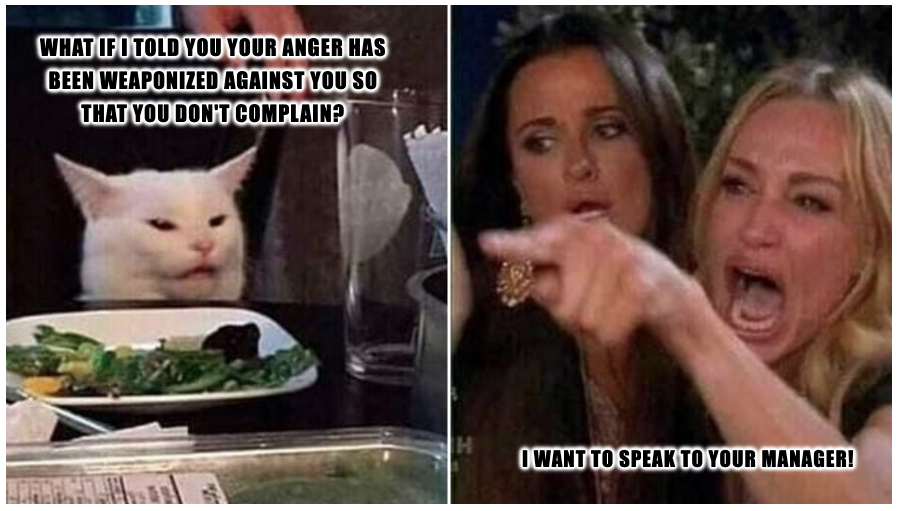
The following tactics touch upon how a meme can shift the cultural narrative while reinforcing corporate interests by manipulating public perceptions of customer behavior. Virally.
Deflection of Accountability
When customers raise complaints or hold companies accountable for poor service or products, businesses label them as “Karens.” This dismisses legitimate grievances and makes customers feel trivialized.
Social media is prime for this. Some accounts for major brands have brilliant minds behind them who speak to followers in a way where meanness is branded as cool and edgy. The customer complaining = joke. The brand dismissing them = relatable.
Marketing Strategy/Ploy
A terrible form of self-policing where corporate interests minimize actual procedural or service concerns.
This is what happened to me with Ralph. I had a legitimate complaint, I was not at fault for procedural incompetence on the part of [your hosting co.]. Forty minutes of incompetence. But the voice in my head? “Am I being a Karen?” Is that not beyond a little fucked up??!?!
Yes, it is. Because that’s the psyop working.
Creating In-Group/Out-Group Dynamics – The OTHERING Dynamic
Corporations use the meme to foster loyalty among customers who wish to perceive themselves as “not a Karen.” This creates a divide: aligning with the brand = cool, complaining = alien.
Not included with the “non-Karen” cool kids at the cafeteria table.
It’s the Mean Girl’ing of American Corporations via meme weaponization. On Wednesdays we wear pink.
The Argument Against the Corporate Utility of “Karen”: A Before and After
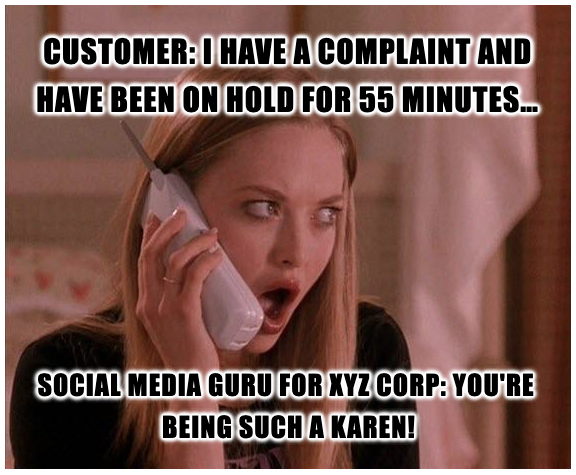
Before the “Karen” Meme:
Customer: “I’ve been on hold for 35 minutes and this issue should take 3 minutes to fix.”Company: [Obliged to address complaint, improve service, or face reputational damage in order to salvage the customer experience]
After “Karen” Meme:
Customer on social media on company’s page: “I’ve been on hold for 35 minutes—”
Company: “Okay Karen 🙄”
Other customers: [Laugh, pile on the commentary, shaming the complainer]
Original customer: [Silenced, shamed, stops complaining]
Company: [Continues to provide shit-level customer service, faces zero consequences, saves tons of money on customer service, wins because of consumer apathy and peer pressure waged from consumer to consumer]
Like a panopticon of corporate capital[7]. And that surveillance? It doesn’t solely police gender – it also polices social standing.
The Class Weapon
The Karen-ing of customers has become a class weapon of sorts.
Rich people, those who can afford higher levels of service and thus are allowed the room to complain, but won’t because those that cater to the high end customer does so with service in mind. If the client does lodge a complaint they aren’t labeled a “Karen”, they are labeled: eccentric or expecting the quality they pay for (handsomely).
However if a middle-class woman lodges a complaint she auto receives the “Karen” label, no matter if the complaints being lodged are valid (which they often are). Instead of receiving value for her money, instead she is labeled as entitled, annoying.
As for the poor people who lodge complaints. They get side-eyed, not acknowledged and told “Well I guess you get what you paid for!”
Clearly end-stage capitalism at the corporate level benefits most when the middle class accept the shit sandwich of service they are given (most consumers = most profit). When the middle class is forced to accept the shit sandwich to avoid being denigrated and labeled with the weaponized Karen label only those at the top with the most to gain, win.
In essence the entire “Karen” meme has been made into a tool to make middle-class women (largest consumer demographic) cease their expectation and stop their demands for quality. Be it product, be it service, be it standards.
It’s remarkably efficient for waging a quiet war on consumers, a war where the clear winner is the profit-loss sheet holder. It’s effective because we are already very aware that:
- Corporations want obedient CONSUMERS, not empowered CUSTOMERS.
- Customer = person paying for service, expects quality, has leverage, demands accountability.
- Consumer = person consuming product, no expectations, no complaints, accepts what’s given, blames self when things go wrong.
The entire ‘Karen’ meme transforms customers into consumers. And consumers don’t complain – they just keep buying. They learned long ago their complaints fall on deaf ears and if they fall out of line, they’ll be made fun of.
Memes as Weapons in Silent Wars
You may believe I’m hyperbolic here, that I’m really reaching about memes as weapons. I promise you, I am not. The fact is that memes aren’t just silly little haha internet microcosms, illustrated guffaws making light of something inconsequential.
They are so much more.
Memes have become widely recognized as tools in information warfare as a tool for persuasion and propaganda. There are multitudes of documented tactics used by governments, corporations, and special interest groups to shape public perception and behavior without the target population even realizing they’re being manipulated.
Yes, I said documented[8]. It’s the secret out on display in the great wide open. Like most big secrets are. Hey! I didn’t make up the rules on this, it’s like pretty factual!
The military has studied memetic warfare. Marketing departments have weaponized viral content. Political operatives have used memes to shift cultural narratives.
A meme is not innocuous, it’s not always just a funny picture with text. It’s a unit of cultural transmission – an idea that replicates, mutates, and spreads through populations, changing behavior as it goes. And like any tool, it can be used for good or ill. A literal cultural virus.
And I’ve already discussed how the “Karen” meme started as grassroots pushback against racist behavior – something truly worth mocking at its most genuine, organic, fundamental level. To believe that it hasn’t been co-opted, engineered for expansion and weaponized? Well that’s just plain ignorance.
The shift from innocuous to cunning has been subtle enough that most everyday people living their everyday didn’t even notice. One day “Karen” meant “white woman calling cops on Black people…then seemingly overnight it meant “any woman complaining about anything.”
That’s not evolution. That’s strategy. And it happened at a time where the world was virtually paying attention to cultural commentary on the internet on an unprecedented level. During COVID lockdowns. What better time to capture the hearts and minds of the multitudes?
Corporations never had to run ad campaigns saying “don’t complain about our service.” They never had to tell women to “shut up and accept poor quality.” All they had to do was let the meme do the dirty work. Allow those deep-rooted mammalian instincts for belonging and blending in do the work. Just sit tight, let social pressure enforce compliance. Let peer shaming replace accountability. You form your OWN panopticon where you police yourself.
Damn. It’s well thought out. It’s absolutely efficient. It’s deniable. And it’s been remarkably effective.
But here’s the thing about memetic warfare: once you see the operation, you can resist it.
The next time you catch even the tiniest thought sprouting up wondering “Am I being a Karen?” Take a deep breath and just pause for a moment.
Then ask instead:
- Am I demanding the service I paid for?
- Am I holding a company accountable for their incompetence?
- Am I asserting reasonable boundaries?
- Am I being a racist?
- Am I weaponizing my privilege against someone?
- Am I calling the cops for a near next-to-nothing reason because I’m petty, or unhappy, or both?
If the answer to those first three questions is yes, and that last one is no – you’re not being a Karen. You’re simply being a customer. Expecting the exchange of money (which is ultimately your time) for quality goods and services.
And corporations have spent considerable effort – millions of dollars in marketing, countless hours of memetic engineering, an entire cultural shift disguised as grassroots mockery – making you forget the difference.
Don’t, not for a second, let them.
This psyop only becomes effective if you police yourself. The shame? It’ll only hit you if you accept it as such. The meme only controls you if you believe complaining about legitimate grievances makes you the problem.
You aren’t the problem. The Ralphs of this world aren’t the problem. The barista who spelled your name wrong isn’t the problem. Your dog? DEFINITELY not THE problem (although he/she may be a generalized menace…I mean we all know dogs aren’t the innocent angels we portray them to be. They have agenda just like every other living creature: namely being loved, housed and sheltered and being exercised in a way that doesn’t create an anxious mess out of them!)
The problem is an ever-growing system that profits from your silence.
Now you see it. Now you can’t unsee it. What you do that is up to you.
Me? I’m done apologizing, for expecting competence. I’m sick of questioning myself for demanding accountability. I’m done letting corporations weaponize shame to extract money while providing shit service.
I paid Ralph’s hosting company for 20 years. I’ll complain about it to all the Ralphs for 20 more if I damn well please.
Maybe that does make me a Karen? Fine. It’s a fact that I’ve been called worse.
In Closing…
This is the work: seeing the systems, naming the observed patterns, refusing to accept the gaslighting that tells you your legitimate complaints are the problem.
This is psychopomp work – reshaping the world by guiding people through thresholds of understanding, helping them see what’s been hidden in plain sight, documenting the corrupt systems designed to silence us.
Grace does this in THE USHERS. She sees the patterns in medical systems, corporate failures, the ways we’re taught to blame ourselves for institutional incompetence. She testifies to it. She refuses to stay quiet.
This is what I’ll be doing here at Edgealia – expanding the footnotes, the observations, the rage and pattern-recognition that doesn’t fit neatly into narrative but demands to be documented.
If this resonated, there’s more coming. Subscribe for notes from the threshold.
Patrz, pamiętaj. Look, remember.
Welcome to the edge.
– Grace (aka Grażyna)
[1] Ralph’s actual indiscernible accent? Call center capitalism with a hint of regional apathy and misogynistic undertones
[2] Get your mind outta the gutter.
[3] .htaccess = short for hypertext access. It’s like your website’s bouncer or even hitman – sharp, effective, and ready to take out any unwanted traffic or vulnerabilities – it does what it does – we don’t ask questions.
[4] Ralph putting me on on hold no less than five times to the tinkling piano rendition of what might have been ‘The Girl from Ipanema’ IF you squinted your ears hard enough, maybe, was enough for me to reconsider my commitment to non-violence.
[5] Is it not ironic that these two share the same last name? Amy Cooper and Christian Cooper: unrelated people, shared last name, opposite sides of a viral moment that became a cultural inflection point during a historic era in history where people were 100% tuned in and locked in their homes, sorta. The universe really does have a dark sense of humor. Or our simulation overlords like to fuck with us. Either is an acceptable argument.
[6] Displacement 101: You’re actually mad that you live in a late-stage capitalist hellscape where corporations extract wealth while providing shit service, but you can’t yell at ‘the system,’ so you yell at Ralph, who’s just trying to get through his shift without his supervisor noticing he’s rewatching Game of Thrones. We’re all displacing rage at the simulation onto each other instead of the architects. The overlords are laughing. The administrators have a lot of paperwork to file in the department of displacement complaints. The victims in all this? The barista who gets your name spelled wrong on your disposable cup…the dog that loves you unconditionally but you choose to kick when you get home…the husband you call a “Karen” because you’re annoyed with your photo processing lab and he chooses to take on a phone call with your health insurance co. that you’ve avoided for weeks. The path to hell is paved with good intentions and all that…
[7] Panopticon: An 18th-century prison design where you can’t see if you’re being watched, so you police yourself just in case. Fast forward 200 years: we totally built our own panopticon voluntarily, we carry it in our pockets everywhere we go, even sleep with the damn thing and we pay a monthly subscriptions for the privilege. Jeremy Bentham, who created this design, is laughing from whatever philosophical afterlife he’s haunting. The simulation administrators are taking notes. You? Well you just fork over more cash to the system that holds you as prisoner, the Karen meme is one of your guards, rec time is between 2-3 p.m., we’ll provide the crafting supplies.
[8] See: NATO Strategic Communications Centre of Excellence reports on the following topics: memetic warfare, military information operations doctrine, and literally any marketing textbook published after 2010. This isn’t conspiracy theory – it’s documented strategy taught in business schools and war colleges. It’s less fun when it’s not just a conspiracy theory, isn’t it? I, Grażyna, am likely on a list now…what threshold person isn’t?